Tuesday, April 15, 2014

Child Health & Human Rights in the Autonomous, Indigenous Communities of Chiapas, Mexico

Greetings from Altamirano, Chiapas, Mexico!
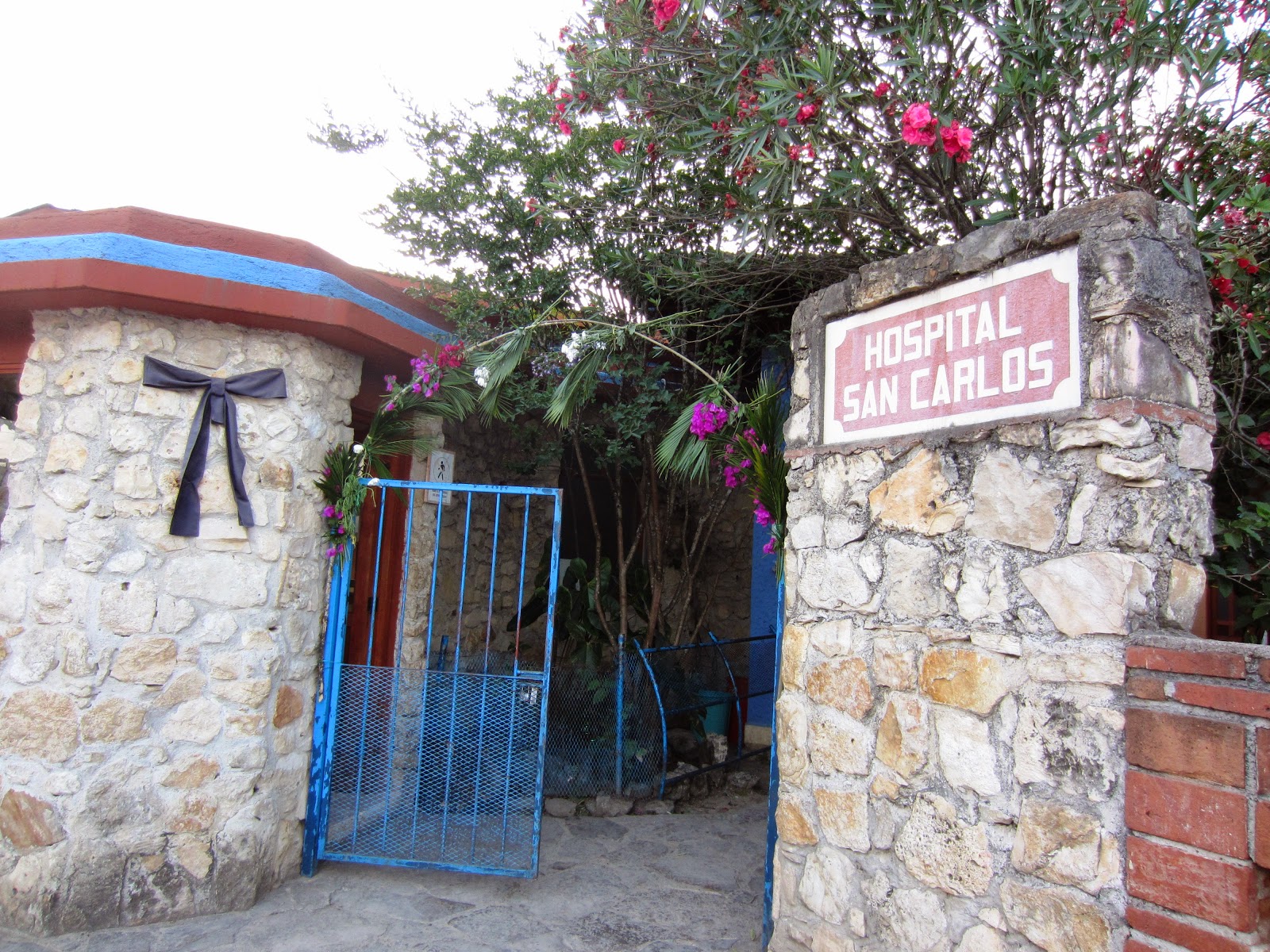
The entrance of Hospital San Carlos on Palm Sunday.
Whether providing clinic care on the pediatric ward or outpatient clinic at Hospital San Carlos, conducting neonatal resuscitation training for nursing students and other hospital staff, or working with Dr. Juan Manuel Canales in surrounding autonomous, indigenous communities, my time in Chiapas has thus far been full of rich, rewarding, and thought-provoking experiences.  At every turn, I am struck by the challenges of providing high quality and accessible healthcare and promoting the health and dignity of children and families here, amidst powerful socioeconomic, political, and systemic determinants and stark health disparities. 

First, a bit of a history lesson … On the day of NAFTA’s signing in 1994, the Zapatista uprising began in Chiapas to defend and demand indigenous rights.  After negotiations with the government stalled, the Zapatistas vowed resistance, refused government services, and created their own autonomous systems of health and education. Thousands were displaced and decades-long militarization and low-level paramilitary violence followed. While Mexico’s human development index has been on a consistent rise over the past several decades, Chiapas has seen little of this progress, despite nationwide development efforts such as Opportunidades.  The state faces Mexico’s highest infant mortality rate and mortality from gastrointestinal infections.  Half of children under five remain stunted, highlighting the high prevalence of chronic malnutrition and the concomitant increased risk of child death.  Notably, most of the children I have cared for in the hospital have been at least moderately stunted (< -2SD ht/age) and wasted (< -2SD wt/ht). Furthermore, paramilitary attacks against the autonomous communities, most recently at the end of January this year, have occurred with impunity and the blind eye of the government. 

Dr. Canales and a promotor on their way to a
vaccination campaign. No photos were taken
in the communities, to protect their privacy.
As I learned on my trips to several autonomous communities with Dr. Canales, the autonomous health systems can include basic clinics run by promotores/promatoras as well as vaccination campaigns. With the support of Doctors for Global Health (DGH), Dr. Canales works with various Zapatista communities, providing training to these promotores/promatoras and helping them plan preventative activities.  Per Zapatista philosophy and official policy, the health promoters are not compensated for their services to their communities. Importantly, vaccinations are always transported and given by the community health workers in order to maintain trust.  While vaccination coverage is strong in these communities, there are often supply shortages.  During the pediatric vaccination campaign that I attended two weeks ago with Dr. Canales and MGHfC Division of Global Health’s, Dr. Jennifer Kasper (who was able to join me for a portion of my trip), HBV, PCV7, and BCG were not available.
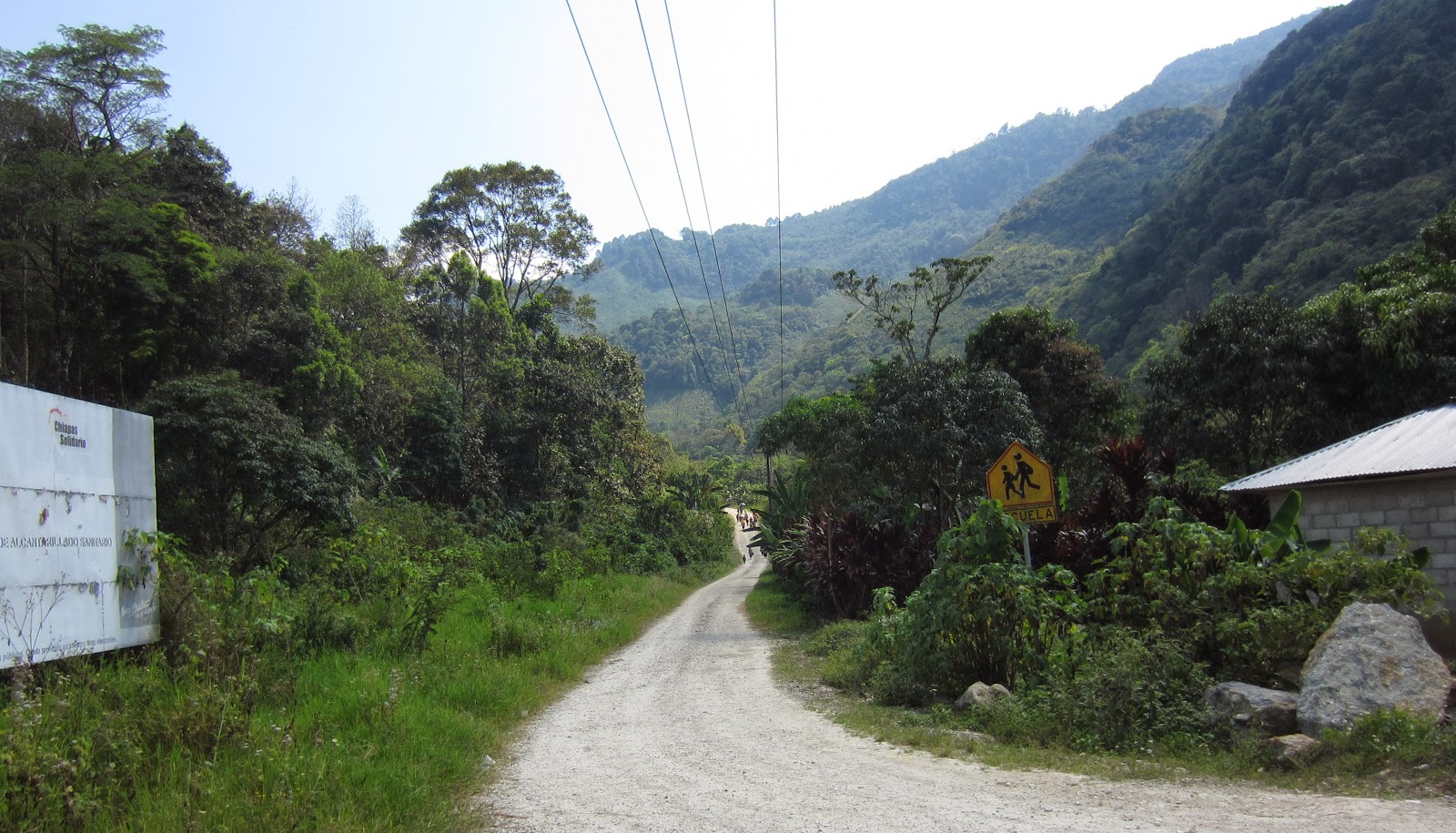


In the distance, families walk along the gravel road;
travel to the hospital can take many hours to a day.
Last week, I had the opportunity to conduct a newborn health / warning signs capacity-building session in one of these communities.  We used videos of ill newborns from the Global Health Media Project to challenge them to identify various such signs.  None of the health promoters had ever seen a newborn with sepsis or severe jaundice, as ill newborns self-triage and make the long trek directly to the hospital.  Typically, this is Hospital San Carlos, a non-government-affiliated safe haven run by an impressive group of Mexican nuns, which I’ll describe more in my next entry.  Though the health promoters I met had not recently experienced any physical violence, they did speak about verbal threats on their homes and land and their day to day struggles, farming corn and coffee, and feeding their families.

Never having worked in the context of autonomous, indigenous communities, I wondered how one would apply a health and human rights framework.  Namely, considering that human rights, including child and adolescent rights to health and education, refer to government obligations to their people, who then is to be held accountable to the children and families in the autonomous communities? In the absence of an accessible and acceptable alternative, the autonomous communities have chosen to have their own autonomous systems of healthcare.  At the same time, they continue to call for the fulfillment of their rights, including their right to health and healthcare.  It seems that this is in line with the United Nations Declaration on the Rights of Indigenous Peoples, a standard to which Mexico is a signatory.  Article 5 of the Declaration states, “Indigenous peoples have the right to maintain and strengthen their distinct political, legal, economic, social and cultural institutions, while retaining their right to participate fully, if they so choose, in the political, economic, social and cultural life of the State.”  Per Articles 21 and 23, and of course other, equally relevant human rights doctrines such as the Convention on the Rights of the Child, this includes, among others, education, sanitation, and health.

Certainly, the Mexican government has the obligation to respect (to not directly violate) and protect (to prevent violation by others) the rights of these indigenous communities.  Impunity in response to paramilitary violence marks an ongoing and unacceptable failure to protect.  Perhaps the obligation to progressively fulfill or realize the rights of indigenous children and families in fact lies at once in the hands of the Zapatista leaders and the Mexican government.  While the State bides its time and turns a blind eye, Dr. Canales and Hospital San Carlos continue their slow and steady campaign in solidarity with the self-determining, indigenous communities of Chiapas, an effort that DGH would call, Liberation Medicine: The conscious, conscientious use of health to promote human dignity and social justice.”  


The beautiful, rolling green landscape of Chiapas.

And I am so grateful to have this opportunity to share in and bear witness to their journey.
Ashkon Shaahinfar, MD, MPH
MassGeneral Hospital for Children
Pediatrics, PGY3


Sunday, March 30, 2014

Maternal health beyond the hospital walls, a perspective from Senegal

Before going to Senegal I had looked up all of the health statistics in preparation for my work.  Maternal mortality is 370/100,000 compared to 20/100,000 live births in the United States.  For Senegal, this is quite an improvement from nearly double that rate in 1990.  Yet, there is still room for improvement and as an enthusiastic, young global health professional, I am trying to figure out my role in the effort.

The natural course would be to work on what I know – training physicians.  Surely there is a need to train more providers and improve the quality of that training, right? In Senegal, the ratio of physicians to population is 1:10,000 (versus 24:10,000) and although there has been an OB/GYN residency training program since 1968 there is still a lack of skilled surgical providers.  Yet in the hospital where I work on the outskirts of the capital, there are 6 part-time OB/GYNs who are all highly skilled and patients receive excellent care.  


We have access to reliable anesthesia, back-up surgeons, pharmacies stocked full of medications, a fairly consistent blood bank, and tertiary care hospitals to receive patients who require ICU level care.  Even more basic than this, but perhaps even more important, there is access to running water, electricity, paved roads, frequent taxis and even the occasional ambulance. These amenities are the norm for this hospital, but consider a rural district hospital a few hundred kilometers outside of the city.  If an OB/GYN is there, they are probably working alone.  They have little back-up.  They may not have anesthesia.  If they want blood, a family member must donate it for fresh whole transfusion.  Hospitals don’t stock medications and though pharmacies may have some of them, patients have to find the money to pay for them.  The referral hospitals are hundreds of kilometers away, and the journey to them is on deteriorating, dangerous roads in whatever vehicles can be found.  If there is electricity, a back-up generator is normally required to accommodate the frequent energy outages and any clean water, let alone running water is a luxury.  It is hard to understand how a physician can work effectively in such settings, let alone live there.

Given all of this as background, perhaps I was fortunate that during my rotation, my team has only lost one patient.  She had a normal delivery at a small community center that was complicated by a retained placenta.  The patient began to hemorrhage and was transferred to our hospital.  On arrival, her hemorrhage spiraled out of control and she showed signs of rapid decompensation.  She was taken to the operating room, her placenta was removed and a transfusion started, but unfortunately it was too late. 

Worldwide, 25% of maternal deaths are attributed to obstetric hemorrhage, making hemorrhage the leading cause of death for women in pregnancy.  Globally, we have seen declines in maternal mortality ratios and programs aimed at improving maternal mortality have taken on some great challenges – training skilled birth attendants, getting clean delivery kits into communities, mobilizing communities to promote prenatal care and delivery in healthcare facilities.  The truth about obstetric hemorrhage, however, and what makes it perhaps the greatest challenge, is that it is unpredictable.  There are few consistent risk factors for hemorrhage and most women who die from obstetric hemorrhage have no known risk factors.  When hemorrhage occurs, women need rapid resuscitation and capable providers with the capacity to intervene surgically.  Our patient had no risk factors, and at the first sign of danger, she needed a bloodbank and skilled, equipped providers at the facility where she delivered - or equally as good, a road and immediate access to an ambulance to get her to somewhere that did. 


While there is still a small piece of global health that I am trained to impact, global health is about so much more than training clinicians.  It is about socioeconomic development, distributive justice, infrastructure and access.  Perhaps it is time for us to take on the more complex systems that affect the health of the populations we seek to improve; to make friends in other areas of development so that governments and societies can create a coordinated approach to improving health.

Rebecca Luckett MD MPH

Tuesday, March 25, 2014

Taking it all in - obstetrics and gynecology in Senegal


This is my first time in Senegal and my first time providing clinical care outside of the United States.  I have made a fair number of rather long journeys to similar locals, but never in a clinical capacity.  In the past I had generally embarked on the journey expecting that I had an idea as to what my role would be, either in a school, a clinic, a public health project, but without an explicit job description. I had been comfortable with that. Coming fresh from a month of nights on a busy labor floor, I stepped off the plane in Senegal and I felt like I should enter back into constant movement and flurry of activities.  The first day at the hospital, I was relieved to find an awaiting cesarean section – I felt immediately useful.  And when down time followed, I found myself anxious about how I would maximize my time –how should I integrate into the resident team?  what should I do in my free time? should I join in a research project?  which presentations should I prepare for my colleagues? I was searching for ways to find the affirmation as an individual that I was accustomed to in residency. 

But I did not come to Senegal to simply be my American resident self, I was here to begin to learn how to be a doctor in a place where I don’t have every amenity and test at my fingertips.  I shifted my outlook over those first few days and paid attention, observed, listened, and asked questions, so that I could begin to understand the system I was going to be working in.  This is a glimpse of what I found.

The labor room.  Only for women ready to push.  As opposed to Boston’s spacious, private rooms with epidurals overflowing, there are three gynecology beds in a row, for three women to labor side-by-side, each to her own rhythm.  The only pain relief is delivery. 


The nursery.  You may have noticed the “nursery” in the picture above.  After birth the babes are cleaned, swaddled and placed in a row on an open table, under regular lamps to keep them warm.  Spooning babies is surprisingly effective soothing while mom is recovering after her delivery.  


The Pinard.  My co-resident pictured above is expert and I am always wishing that I had smuggled a bedside Doppler into my luggage to find each babies’ heartbeat. 


The operating room.  No bells and whistles, but with everything we need.  After scrubbing and prior to opening the sterile box of instruments, it is always a mystery as to which instruments you will find.  It is typically no more than 15 instruments, many of which are different from the last kit used.   We return to surgical basics and make instruments work for us.


Anesthesia.  General is rarely needed though available with manual ventilation as pictured below.  Nearly all gynecologic procedures are performed under regional anesthesia.  Fortunately, both the gynecologists and general surgeons do extremely challenging surgeries within the time constraints of regional anesthesia.  


Indications for surgery.  Fibroids were by far the most common reason for gynecologic surgeries.  These are typical specimens from one patient - every last one comes out.  


Operating with general surgeons.  I have not assisted a general surgeon, let alone had a male patient on the operating table since my third year of medical school. Yet the general surgeons here do a fair amount of gynecologic surgery and thus are incredibly valuable teachers. 

Fortunately, despite some of the contrasts highlighted here, the human body and gynecologic pathology are fairly constant whether you are in Boston or Senegal.  That keeps me breathing easy while I continue on this incredible and humbling journey.

Rebecca Luckett MD MPH

Sunday, March 23, 2014

Learning about Task Shifting


Pictured above: Sangath, Goa

Neuropsychiatric diseases like unipolar depressive disorders, addictions, bipolar disorder and schizophrenia make up 28% of the global burden of disease among noncommunicable diseases and are economically more disabling than cardiovascular disease or cancer. When you add infectious diseases, neuropsychiatric disorders make up 14% of the entire global burden of disease. While access to mental health is essential to improving quality of life among people and economies of the world, there is a dearth of resources. How do we address the need? Vikram Patel MD, a psychiatrist at the London School of Hygiene and Tropical Medicine is doing fascinating research in task shifting, the idea of training community health workers to handle psychiatric interventions with supervision, as an answer to the need. I was lucky to get a chance to visit his clinical trial center in Goa, India.

With India's population of over 1 billion people, they require at least 150,000 psychiatrists. Currently, they have around 3000 psychiatrists meeting about 2% of the country's need.  The idea of task shifting is to train community health workers to carry out psychosocial interventions. Chosen community health workers are those who are dedicated to their community's psychological health and understand the cultural contexts within which mental illness exists in their society. I got a chance to meet these wonderful women at Sangath, Goa. They go out to primary care centers to do prescribed therapies that have shown to be helpful in addiction and depression.


For the trial Sangath recently did (MANAS trial), the community health workers use depression and addiction scales to screen and triage patients in primary care centers who are having trouble with depression and alcohol abuse. Those who screened positive would either be assigned to the control group or see a community health worker for 6-8 cognitive behavioral therapy sessions to treat depression or addiction. In the picture below, you will see the packets the community health workers use to do the therapy and assess improvement behind them.


The community health workers get supervision weekly with more senior counselors on difficult cases and meet with a psychiatrists at least once a month. They are connected to referral services for urgent and more medically complicated cases. These trials have shown a significant impact to improving depression and addiction in this community.

It was a wonderful experience for me to see people trying creative solutions to major problems to accessing mental health care. It's a great way to involve the community, to help create sustainable resources, build capacity in a health system, and reduce the stigma of mental health.

Jhilam Biswas, MD

Tuesday, March 4, 2014

Pediatric Medical Education in Mbarara, Uganda

Before my arrival in Uganda I had read numerous articles on commonly seen conditions, spoken with residents and attendings who had previously worked at Mbarara Regional Referral Hospital (MRRH), and did my best to familiarize myself with cultural practices.  However, nothing could have prepared me for the reality of working at MRRH.  I am privileged to train in a country and hospital where essentially no resource or specialist is more than a phone call away.  There is almost always another test or procedure which can be performed to try to reach a diagnosis, and many third (or fourth or fifth) line treatments available before we tell a patient or their family that there are no further options.  At MRRH, the residents and students practice in an environment where they are never certain what resources might be available that day – do we have patient files or order forms, oxygen available for those in respiratory distress, or appropriate antibiotics for any of the numerous infectious processes encountered daily?  The answer is dynamic, changing from one hour to the next.  Too few nurses leads to the residents and students checking vital signs on rounds and family members administering most oral medications and alerting care providers to changes in a patient’s condition.  There are limited diagnostic tests available, and the providers learn to live with a high level of uncertainty. 


Saturday, February 22, 2014

Thankfully we were also able to experience a little Vietnamese culture throughout the two weeks. I have posted several pics, including our visit to the Chu Chi Tunnels ( a major communist community that was a major battle ground during the Vietnam War). As you can see, we were able to explore the tunnels. It was a little claustrophic for sure!


Below are pics from our trip to the Mekong Delta, a small region south of Ho Chi Minh City, which is home to approximately 30 million people.


Vietnam is famous for it's vast selection of tropical, delicious, fruits. Truly the best fruit I have ever had.


Sadly, here is a pic of one of my final clinic days with Dr. Minh and Dr. Famy. This morning we saw 96 patients in a half day! Such a need for dermatology here. The work ethic of these physicians is just phenomenal.


2.17.2014

Greetings from Vietnam!

I have now been working with the brilliant dermatology faculty and residents of Ho Chi Minh City College of Pharmacy and Medicine for one week and I must say this has been one of the most memorable and impressionable learning experiences I have encountered throughout residency. 

A little background for you….. For years, the country of Vietnam has lacked the appropriate means for effective, early intervention of disfiguring vascular anomalies.  The standard of care has historically included the use of radioactive phosphorus for infantile hemangiomas and even in some cases vascular malformations. This treatment is not only painful for the children but leaves behind disfiguring, stigmatizing, and painful scars, many of which are located in the facial region. Five years ago, Dr. Thanh Nga Tran and Thuy Phoung (both natives of Vietnman) decided they would put a stop to this treatment once and for all. Both having trained in the Harvard Dermatology and Dermatolopathology programs respectively, they determined to join forces with Dr. Rox Anderson (expert in the laser and medical treatment of vascular anomalies) and Dr. Martin Mihm (expert in vascular anomalies and dermatopathology).

Dr. Tran spent one month at the Ho Chi Minh College of Pharmacy and Medicine as a senior dermatology resident and during this time made contact with two of the most honest, hard-working, and caring dermatologists any of us has met, Drs. Hoang Minh and Bo Famy. Together, this remarkable team of physicians established the first vascular anomalies clinic of Vietnam five years ago this month.

The clinic began with 1 laser, the pulsed dye laser, an operating room with anesthesiologist, a team of eager residents, and of course a line of patients. Through much fund-raising and generous donations from various laser companies, the OR is now replete with the top four lasers needed for the treatment of various vascular anomalies. This accomplishment in only five years time is truly remarkable.

Now for the present…..Upon arriving in Vietnam at 1:30 AM, the hospitality of this program was evident immediately. Second year resident- Anh Dao was there with her little brother holding a sign with my name as soon as I exited the airport in Ho Chi Minh City. I must say this was so comforting having never been to this country and not speaking the language.

Our first day in clinic was truly an eye-opening experience. It began with the evaluation of several children with disfiguring scars from the treatment with radioactive phosphorus. In the year previously, Dr. Anderson was able to bring a new device that he invented which harvests a “blister graft” from the thigh, which can then be grafted to the site of a scar (after superficial epidermal ablation).  He trained Drs. Famy and Minh on the utility of this device and they were able to treat several of the children in the last year. The results are truly remarkable!  Nearly normal pigmentation and texture resulted. This is life changing for these children whose scars are located in the facial region. Additionally, this is ground breaking in the treatment of radiation injury. Thankfully, we were able to treat several additional children during our time this year.

Additionally, we evaluated and treated numerous children with hemangiomas, capillary malformations, lymphatic malformations, and venous malformations.
It was amazing to observe how brave these children are here. They literally walk into a room of 15-20 physicians and sit in the middle quietly while we discuss the treatment plan. 

A great deal of our time was also spent teaching the residents and attendings how to develop treatment plans, including the use of medical management, such as topical timolol and oral propranolol, in combination with laser treatment.  At the end of the week several members of our group spoke at the annual CME conference held at the University. Much to our surprise, this year’s attendance hit a record high of over 500 doctors from across Vietnam!


Monday, February 17, 2014

Collaboration in Pediatric Medical Education and Clinical Care in Mbarara, Uganda

I walk into the admissions room for the “Toto” Pediatric Ward at Mbarara Regional Referral Hospital in Uganda and the intern on-call looks up at me with an anxious smile.  In this room there is a small bench, where two mothers sit with their toddlers, prostrate on their laps, one tachypneic, the other pale with visible scleral icterus.  The intern is admitting both children - checking vitals, writing admission notes, placing orders, inserting IV catheters, and ensuring these two patients receive their medications promptly.  I glance over at the single exam table where there is a small bundle – I lift the blanket and find two premature twins, each less than 1kg, swaddled together under a bare bulb for warmth.